




How to Choose an Inline Checkweigher: Accuracy, Speed and Range Explained
An inline checkweigher weighs every package as it moves along your production line, rejects underweight or overweight packs, and keeps your output consistent. But picking the wrong model — too small a range, too low a speed, or a platform that does not fit your pack — means wasted money and avoidable quality issues. This guide walks through the four specs you must match to your product before you order.
What Is an Inline Checkweigher?
An in-motion checkweigher sits after your filler or packaging machine. Products travel across a weighing platform on a conveyor belt; a load cell measures each pack in real time; a rejector removes anything outside the target weight range. It catches underweight packs that would trigger customer complaints or recalls, and overweight packs that cost you raw material on every unit.
For food lines, the machine should be built in food-grade stainless steel, with an easy-to-clean belt and a touchscreen that stores product recipes for fast changeovers.
Four Specs to Match Before You Buy
-
Weight Range
Start with your lightest and heaviest pack, including any giveaway or filler variation. The checkweigher's range must cover both ends with margin — do not buy a machine that only just reaches your target weight.
- Light pouches, sachets and small bags: low-range models with fine graduation
- Standard pouches, bags and boxes: mid-range models
- Large bags, cartons and bulk packs: heavy-duty models with a pusher rejector
Send your actual samples to the supplier and have them weighed on the matching model before ordering. Do not rely on catalog guesses.
-
Accuracy
Accuracy is usually stated at 3σ (three standard deviations). The tighter your tolerance, the finer the load cell and graduation you need.
- Fine accuracy (±0.1–0.3g): small packs, light fill, premium segments
- Standard accuracy (±1g): snacks, biscuits, pouches and most packaged food
- Heavy accuracy (±5–15g): large bags and bulk packs
Accuracy also depends on a stable product, a clean belt and a properly calibrated load cell — no machine holds its spec if the line vibrates or the product effect changes.
-
Throughput Speed
Match the checkweigher's max speed to your line output, not the other way around. If your packaging machine runs 120 packs per minute, a weigher rated for 80 pcs/min becomes the bottleneck.
- Fine, small packs: higher speed, smaller platform
- Large, heavy packs: lower speed, wider platform and heavier rejector
-
Platform Size and Product Shape
Check the platform width and length against your pack dimensions, plus any guides or side rails. A pouch needs a different platform than a rigid box or a frozen block.
FA-CW Series Range at a Glance
Fanchi-tech FA-CW checkweighers are built in SUS304 stainless steel with PU anti-static belts, a 7-inch LCD touchscreen, 100 product recipes and an HBM high-accuracy load cell.
Light-to-Medium Range (Pouches, Bags, Boxes)
|
Model
|
Weight Range
|
Scale Interval
|
Accuracy (3σ)
|
Max Speed
|
Platform (W×L mm)
|
|
FA-CW160
|
3–200g
|
0.01g
|
±0.1g
|
250 pcs/min
|
160×200/250/300
|
|
FA-CW230
|
5–1000g
|
0.1g
|
±0.2g
|
200 pcs/min
|
230×250/350/450
|
|
FA-CW300
|
10–4000g
|
0.1g
|
±0.3g
|
150 pcs/min
|
300×350/450/550
|
|
FA-CW360
|
10g–10kg
|
1g
|
±1g
|
120 pcs/min
|
360×450/550/800
|
|
FA-CW450
|
10g–10kg
|
1g
|
±1g
|
80 pcs/min
|
450×550/700/800
|
Heavy Range (Bags, Boxes, Bulk Packages)
|
Model
|
Weight Range
|
Scale Interval
|
Accuracy (3σ)
|
Max Speed
|
Rejector
|
|
FA-CW500
|
0.1–25kg
|
1g
|
±5g
|
40 pcs/min
|
Heavy Pusher
|
|
FA-CW600
|
0.1–50kg
|
1g
|
±10g
|
35 pcs/min
|
Heavy Pusher
|
|
FA-CW700
|
0.1–60kg
|
1g
|
±15g
|
35 pcs/min
|
Heavy Pusher
|
Reject options for light-to-medium models include flipper, pusher, flapper, air blast and drop-down, depending on your product and line layout.
Why a Factory-Direct Checkweigher Matters
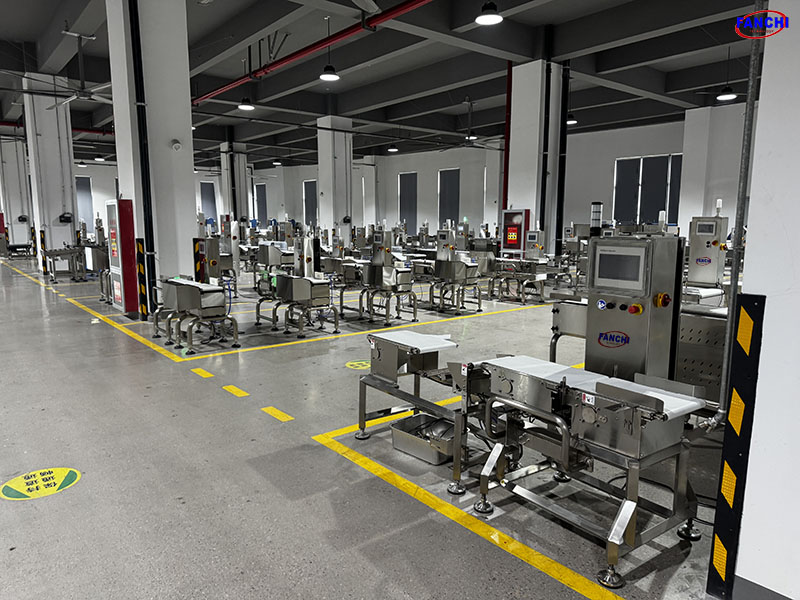
[FA-CW inline checkweighers on the Fanchi-tech Shanghai production floor, white PU anti-static belt checkweigher for pouches, bags and boxes, SUS304 stainless steel frame with 7-inch touchscreen]
FA-CW series checkweighers assembled and run-tested on our Shanghai floor before export. Each unit is calibrated and checked by our engineers before packing.
When you buy direct from the manufacturer, you deal with the team that built and calibrated the machine — not a trading company reselling someone else's brand. On our floor, every checkweigher is run-tested and calibrated before packing, so what arrives on your line has already passed a real production check. Standard common parts mean local technicians can handle routine maintenance, and the machine can be configured to your product recipes and line height.
Common Mistakes When Choosing
- Choosing by price only: a cheaper lower-spec weigher that cannot hold your tolerance will cost more in rejects and complaints.
- Ignoring line speed: the weigher becomes the bottleneck if its speed trails your packer.
- Skipping sample testing: send real packs, not descriptions, and verify the machine holds accuracy on your product.
- Underestimating platform size: a pack that tips or slips on the belt gives false weights.
- Forgetting the rejector: heavy packs need a pusher; light pouches can use a flipper or air blast.
FAQ
What accuracy do I need for a food checkweigher?
Match accuracy to your tolerance and pack weight. Small, light packs usually need ±0.1–0.3g; standard packaged food often works at ±1g; large bulk packs run at ±5–15g. Test your samples to confirm.
How fast should my checkweigher be?
It should keep up with, or exceed, your packaging machine's output. If your line runs 120 packs per minute, choose a weigher rated above that speed.
Can one checkweigher handle different package sizes?
Yes, within a model's range and platform size. Recipe memory lets you save settings per product, but very different pack sizes or weights may need a different model.
What is the difference between a checkweigher and a metal detector?
A checkweigher verifies weight and removes over/underweight packs; a metal detector searches for metal contamination. They are often placed in sequence on the same line, and can be combined in one inspection system.
Get a Checkweigher Matched to Your Product
Send us your product type, target weight range, pack dimensions and line speed. We will test your samples on the matching FA-CW model and send a factory-direct recommendation.
Contact:
Kerry
Email: kerry@fanchitech.net
WhatsApp: +86 139 17555254
YouTube: youtube.com/@fanchitech3323
About the author
Kerry is an export specialist at Fanchi-tech, helping food processors across 50+ countries set up automatic weight inspection lines.
Post time: Nov-12-2026