




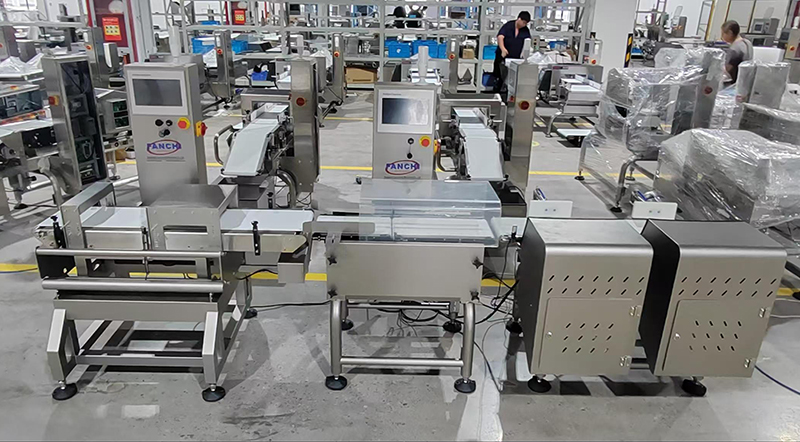
Aluminum Foil Metal Detector & Checkweigher Application Case Study: Improving Safety and Quality Control in Ready-to-Eat Meal Production
1. Industry Background
The global ready-to-eat (RTE) meals market has maintained steady growth over the past decade, driven by rapid urbanization, fast-paced lifestyles, and rising demand for convenient, heat-and-eat food products. North America and Western Europe remain the largest regional markets, with supermarkets, convenience stores, and catering services as the main distribution channels. Alongside market expansion, food safety regulations in these regions have become increasingly stringent. Regulatory bodies such as the U.S. FDA and EU EFSA enforce zero tolerance for physical contaminants in food products, and third-party food safety standards including HACCP, BRC Global Standards, and IFS Food mandate 100% inline inspection as a core requirement for quality management systems.
Metal contamination and incorrect net content are the two leading causes of food product recalls in the RTE sector. For products packaged in aluminum foil trays — a widely used format for ready meals, frozen dinners, and prepared dishes — quality control faces unique challenges. Standard conveyor metal detectors cannot distinguish between the aluminum packaging and actual metal contaminants inside, resulting in extremely high false reject rates and making conventional inspection solutions unworkable. This gap has created strong demand for specialized aluminum foil metal detector systems paired with inline weighing solutions.
2. Customer Production Challenges
This case involves a mid-sized ready meal manufacturer based in Bavaria, Germany, supplying aluminum-tray packaged prepared foods (including pasta dishes, curries, and slow-cooked meat meals) to major retail chains and airline catering services across the EU.
- Product characteristics: Single-serve portions ranging from 250g to 500g, packed in rectangular aluminum foil trays with heat-sealed lidding film.
- Production capacity: 65 packs per minute on a continuous packaging line, operating two shifts per day.
- Contamination risks: Metal debris can originate from multiple points in the production process: worn stainless steel blades and screws from vegetable cutting equipment, metal fragments from meat grinding machinery, loose parts from filling machines, and small wire pieces from processing screens.
- Prior quality control pain points:
- Standard conveyor metal detectors failed to work with aluminum packaging, with false alarm rates exceeding 30%, causing frequent line stops and an estimated 15% loss of daily output.
- Manual weight sampling (5 units per hour) was slow, inconsistent, and prone to human error, resulting in repeated customer complaints and retailer fines for net content violations.
- The lack of 100% inline inspection created a major barrier to achieving BRC Grade A certification, limiting access to premium retail accounts.
- One recorded incident of stainless steel debris found in a finished product triggered a partial product withdrawal, causing significant brand reputation damage and recall costs.
3. Why Traditional Inspection Methods Were Not Enough
Before adopting the Fanchi-tech solution, the customer relied on a combination of manual checks and standard detection equipment, all of which proved insufficient for aluminum-packaged ready meals:
- Manual inspection limitations: Visual inspection cannot detect internal metal contaminants, and manual weighing is too slow to keep pace with high-speed production lines. Operator fatigue leads to inconsistent accuracy over long shifts, and labor costs for full manual coverage are prohibitively high.
- Standard metal detector limitations: Conventional metal detectors react to all metal materials. Aluminum foil packaging generates a strong signal that triggers constant false alarms, making the equipment effectively useless for foil-packed products.
- Sampling inspection risks: Batch sampling covers only a tiny fraction of total output. A single contaminated or underweight product that slips through can lead to costly recalls, regulatory penalties, and permanent loss of customer trust.
- Compliance gaps: Global food safety standards and retailer audit requirements demand full traceability and 100% inspection of critical control points. Sampling-based quality control cannot meet these requirements and risks losing market access.
4. Fanchi-tech Solution
To address these specific challenges, Shanghai Fanchi-tech Machinery Co., Ltd. delivered a customized Metal Detector & Checkweigher Combination system optimized for aluminum foil packaging.
Fanchi-tech Aluminum Foil Metal Detector & Dynamic Checkweigher
- Detection principle: The metal detection module uses advanced digital phase adjustment technology. Through intelligent algorithm calibration, it identifies and cancels out the base signal generated by the aluminum foil packaging itself, isolating only the signal from internal metal contaminants. This enables reliable detection of ferrous metals, non-ferrous metals (copper, brass, aluminum), and stainless steel particles inside foil trays.
- High-precision weighing: The checkweigher module integrates a high-resolution load cell with advanced dynamic weighing algorithms, delivering stable weight measurement even at full production speed. It automatically compares each product’s weight against preset upper and lower limits.
- Automatic reject system: Equipped with a pneumatic push-type reject mechanism, the system automatically diverts non-conforming products (either metal contamination or out-of-tolerance weight) into a dedicated lockable reject bin. The entire process runs without line stoppage and does not disrupt production rhythm.
- Line integration: The machine features a standard conveyor design with adjustable inlet/outlet heights, allowing direct in-line installation between the aluminum foil sealer and case packer. No major line modifications are required, minimizing installation downtime.
- Operation and traceability: A 7-inch color touchscreen HMI supports storage of up to 100 product recipes for one-click parameter switching. All inspection data — including detection events, weight readings, and reject counts — is logged and exportable for quality traceability and audit purposes.
5. Machine Configuration Matching This Application
The delivered system was sized and calibrated specifically for the customer’s ready meal product range, with specifications perfectly matched to their production requirements:
- Conveyor width: 300mm, designed to accommodate standard rectangular aluminum foil trays with stable product transfer.
- Detection aperture: 400mm (W) × 200mm (H), providing sufficient clearance for both single-serve and family-size aluminum meal trays.
- Product weight range: 50g – 1000g, covering the customer’s full portfolio from individual portions to multi-serve packs.
- Production speed: Rated for up to 80 packs per minute, comfortably handling the customer’s current 65 ppm line speed with headroom for future capacity increases.
- Material compatibility: Optimized for aluminum foil, metallized film, and other metal-containing packaging materials, with a false reject rate below 0.1% under normal operating conditions.
- Hygienic design: Full 304 stainless steel construction with smooth, crevice-free surfaces and IP65-rated protection for washdown environments, meeting EU food contact material standards.
6. Application Process
Integrated into the customer’s end-of-packaging line, the combined inspection system completes both metal detection and weight verification in a single pass. The full production flow is as follows: Raw Material Preparation → Cooking & Tray Filling → Aluminum Foil Sealing → Inline Aluminum Foil Metal Detection & Dynamic Checkweighing → Automatic Rejection (defective products) → Case Packing → Warehousing
Installed immediately after the foil sealing station and before secondary packaging, the system performs 100% inspection of every finished pack. All inspection results are time-stamped and linked to production batches, supporting full forward and backward traceability as required by HACCP and retailer quality programs.
7. Customer Benefits
Six months after installation and commissioning, the customer achieved measurable improvements across safety, efficiency, compliance, and cost:
- Reduced contamination risk: Zero confirmed metal contaminant escapes, with no further customer complaints or product withdrawals related to foreign bodies. This eliminated the risk of six-figure recall costs and protected brand equity.
- Improved production efficiency: False alarm stoppages were eliminated entirely, raising overall line efficiency by 18%. Daily output per shift increased from 5,200 to 6,100 packs without additional labor.
- Reduced customer complaints and returns: Weight non-conformity rate dropped from 1.2% to 0.15%, cutting retailer complaints by 90% and eliminating all net content fines.
- Met food safety standards: The manufacturer successfully achieved BRC Grade A certification, opening access to premium supermarket chains and airline catering contracts.
- Enhanced export competitiveness: Full compliance with EU food safety regulations and FDA-equivalent standards enabled successful market entry into Nordic countries.
- Labor cost savings: Replaced three full-time quality inspectors previously assigned to manual sampling, generating annual labor cost savings of approximately €45,000.
8. Why Choose Fanchi-tech
Shanghai Fanchi-tech Machinery Co., Ltd. is a professional manufacturer specializing in food inspection and weighing solutions with over 10 years of industry experience.
- Expert manufacturing: Focused exclusively on food-grade inspection equipment, with in-house R&D, production, and testing capabilities.
- Global project experience: Equipment exported to over 30 countries, with on-site installation and service support through local partners across Europe, North America, and Southeast Asia.
- Customized solutions: Tailored aperture sizes, conveyor lengths, and reject mechanisms to fit unique product dimensions and production line layouts.
- Regulatory compliance: All products carry CE certification and ISO 9001 quality management certification, fully compliant with EU and North American food equipment safety standards.
- Cost-effective performance: Delivers equivalent detection and weighing performance to premium European brands at 30–40% lower total cost of ownership.
9. FAQ
Q1: Can this aluminum foil metal detector inspect products packaged in aluminum foil trays? A: Yes. This machine is purpose-built for metal-containing packaging. It uses digital phase adjustment technology to cancel out the signal from the aluminum foil itself, allowing accurate detection of ferrous, non-ferrous, and stainless steel contaminants inside the package.
Q2: What detection sensitivity can be achieved for aluminum foil packed ready meals?
A: For standard 250g aluminum tray ready meals, typical sensitivity is Fe 0.5mm, Non-Fe 0.8mm, and SUS 1.0mm, meeting the strictest food industry contaminant control requirements.
Q3: How accurate is the dynamic checkweigher on this combination machine?
A: At typical production speeds of 60 packs per minute, dynamic weighing accuracy is ±0.5g with excellent repeatability, fully complying with net content labeling regulations.
Q4: Can this metal detector and checkweigher combo be integrated into our existing packaging line?
A: Yes. The machine uses a standard conveyor design with adjustable infeed/outfeed heights, and can connect directly to most commercial sealing and packaging machines. We also provide on-site installation and commissioning support.
Q5: What happens when the machine detects a metal contaminant or out-of-tolerance weight?
A: The integrated automatic push reject system activates immediately, diverting the defective pack into a dedicated lockable reject bin. The line continues running without interruption.
Q6: Does this equipment support HACCP and BRC certification audits?
A: Yes. The machine features food-grade 304 stainless steel construction, hygienic design, and complete data logging and traceability functions, all of which help customers pass HACCP, BRC, IFS, and other GFSI-recognized standards.
Q7: What is the maximum production speed this combination machine can handle?
A: The standard model supports up to 80 packs per minute. Higher-speed customized versions are also available for ultra-high-speed production lines.
Q8: Can you customize the detection aperture and conveyor width for our specific product dimensions?
A: Absolutely. We offer full customization of aperture size, conveyor width, and conveyor length to match unique product specifications and production line layouts.
Q9: What routine maintenance does the machine require?
A: Under normal operating conditions, daily conveyor belt cleaning and weekly sensitivity verification are sufficient. We provide a detailed maintenance manual and regular remote after-sales follow-up.
Q10: Besides aluminum foil, what other packaging types can this metal detector handle?
A: In addition to aluminum foil trays, it works with metallized film, metalized laminate, and other metal-containing packaging, as well as standard plastic, paper, and glass packaging formats.
Post time: Sep-09-2026