




X-Ray Liquid Level Inspector for Can and Bottle Beverage Lines


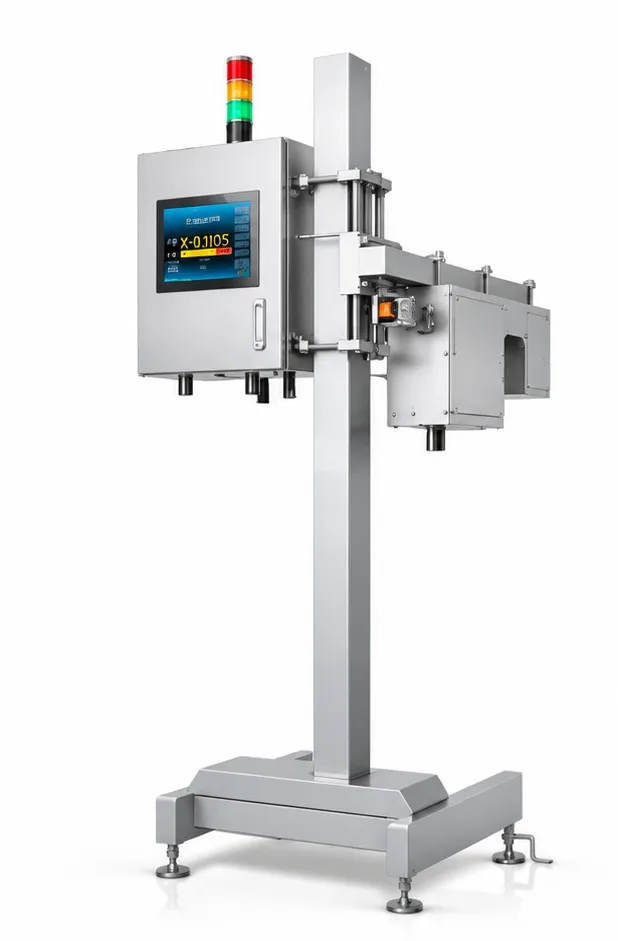
X-Ray Liquid Level Inspector
Non-contact, in-line fill-level inspection for two-piece and three-piece cans, glass bottles and PET bottles. The system measures the actual liquid level inside every container at line speeds up to 1,500 containers per minute.
- Maximum speed: 1,500 CPM
- Liquid level deviation: ±1 mm
- Rejection rate: ≥99.9%
- False rejection rate: ≤0.3%
Why fill level is the defect you cannot see
In beverage packaging, the stability of the filling machine and the skill of the operators both vary through the shift. The result is containers that leave the line over-filled or under-filled, and neither defect is visible from the outside of an opaque can or a labelled bottle.
- High liquid level: over-filled containers affect product quality and generate consumer complaints. The usual root cause is a filling machine fault that no downstream sensor is checking for.
- Low liquid level: under-filled containers still reach the market, so the defect is only discovered by the consumer. Manual spot checks are too sparse to catch a filling head that drifts between checks.
What manual inspection and checkweighing cannot solve
- Inspectors fatigue during long shifts, so detection accuracy is not stable.
- Accuracy is highly affected by production line speed.
- Manual inspection has low precision and a large uncertainty factor.
- Labour cost keeps rising while headcount on the line keeps growing.
- Weighing a filled container cannot separate the weight of the container and the liquid accurately, so net fill level stays uncertain.
How the X-Ray Liquid Level Inspector measures fill level
A low-energy photon source is directed through the container as it passes on the conveyor. The radiation intensity reaching the receiving tube changes with the material level position inside the container, so the system calculates the fill level directly – without touching, weighing or slowing the product. Because measurement is non-contact, it solves the problem that conventional weighing methods cannot accurately measure the capacity of filled liquid on a running line.
The system is made up of three parts:
- Detection unit – high-voltage power supply, radiation emitting tube and radiation receiving tube, mounted across a single-row conveyor chain.
- HMI control platform – 11 inch colour touchscreen, tower light and operation interface. All product parameters are set and stored here, with up to 10 product recipes.
- Rejector – independent programmable rejection output ejects non-conforming containers. Timing is driven by a precision strike encoder for accurate positioning at speed.
Structural features
- Non-contact detection – no product contact, no mechanical wear, no risk of damaging the container
- Digital signal processing on the latest DSP platform, for stable readings at 1,500 CPM
- Colour touchscreen human-machine interface with multi-language support
- Parameters for 10 different products stored and recalled on changeover
- 10 sets of reject data retained for traceability and line review
- Independent programmable rejection module: reject containers, retain containers, encoder, rejection indicator light, alarm and rejector status output
- Alarm information displayed on screen, including a continuous reject alarm that flags a line fault instead of hiding it
- Electric control cabinet rated up to IP65
- Precision strike timing encoder
- Network remote control (optional)
Installed on the line
The inspector sits over a single-file conveyor chain – after the filler and seamer, or after pasteurisation – and rejects non-conforming containers before they reach packing. No bypass lane and no accumulation table are required.
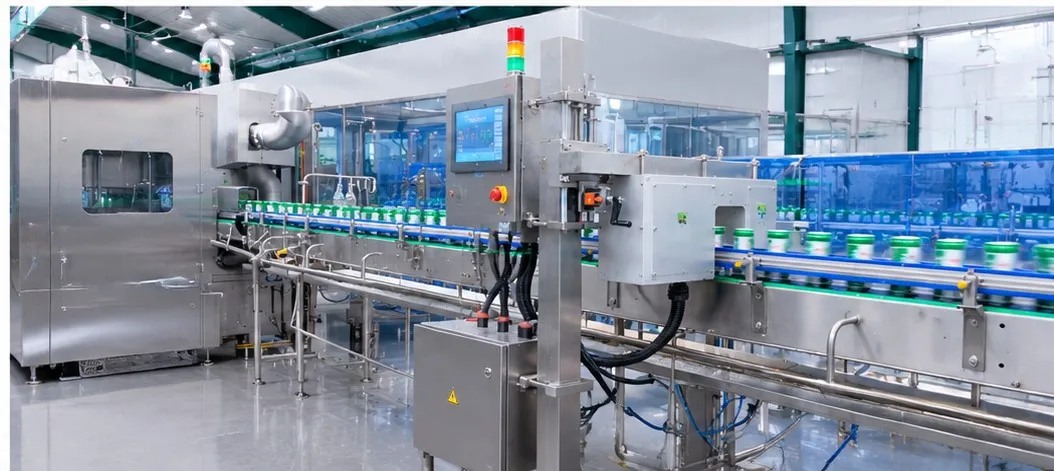
Detection unit and rejector above a single-row can chain, with tower light status visible to operators.
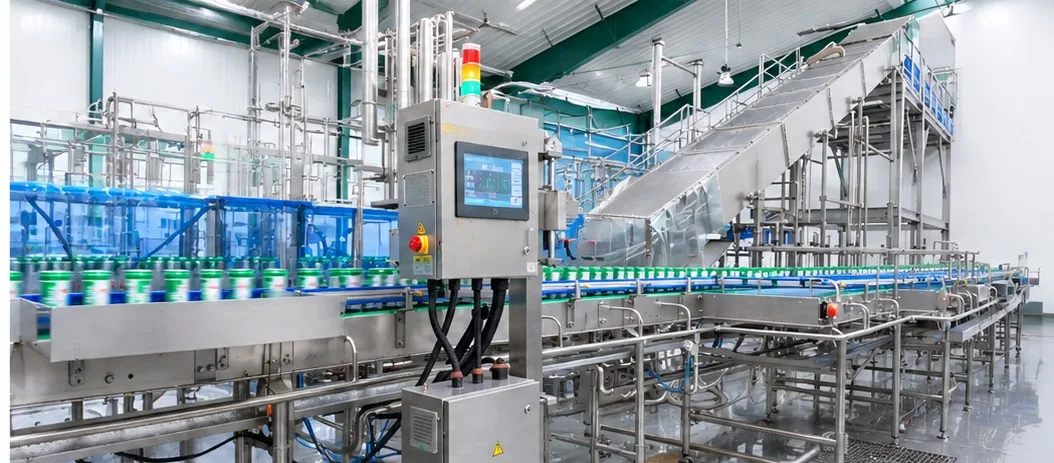
Typical position on a high-speed beverage line, upstream of the inclined conveyor and packing area.
Technical parameters
Standard specification for a single-row conveyor installation.
| Parameter | Specification |
|---|---|
| Dimensions (L × W × H) | 743 × 896 × 1,926 mm |
| Max detection speed | 1,500 CPM (containers per minute) |
| Power | 0.25 kW |
| External power source | AC 220V, single phase |
| Operating temperature | 0 °C – 45 °C |
| Altitude | < 3,000 m |
| External air source pressure | > 0.5 MPa |
| External air source flow | > 500 L/min |
| External air interface | φ10 OD tubing |
| Rejector air consumption | ≈ 0.01 L per cycle |
Inspection standards
Both high and low fill level are detected against the container format programmed for the current product.
| Inspection item | Liquid level deviation | Rejection rate | False rejection rate |
|---|---|---|---|
| High liquid level | +1 mm | ≥99.9% | ≤0.3% |
| Low liquid level | -1 mm | ≥99.9% | ≤0.3% |
Applicable containers and lines
The X-Ray Liquid Level Inspector is applicable to two-piece cans, three-piece cans, glass bottles, PET bottles and other bottle or can formats. Product recipes are created and stored for each format, so changeover is a recipe recall rather than a mechanical adjustment.
- Two-piece and three-piece cans – beverage and beer canning lines
- Glass bottles – glass bottle beverage lines
- PET bottles – PET bottle beverage lines
- Up to 1,500 CPM on a single-row conveyor installation
The number of container formats covered is confirmed per project against your sample bottles or cans before the layout drawing is issued.
Key components and brands
| No. | Component | Brand / Origin |
|---|---|---|
| 1 | Touch screen | WEINVIEW, 11 inch |
| 2 | High voltage power supply | WISMAN (Xianyang) |
| 3 | X-ray receiving tube | HAMAMATSU (Japan) |
| 4 | Photo-electronics | OMRON, KEENSHI (Japan) |
| 5 | Cylinder | SMC (Japan) |
| 6 | Signal lamp, circuit breaker | Schneider |
| 7 | X-ray emitting tube | KEYWAY (Shanghai) |
| 8 | Industrial fan | LEIZIK (Australia) |
| 9 | Encoder | ECO (Swiss) |
| 10 | Solenoid valve | MAC (USA) |
Installation and site requirements
Share your line layout and a sample container with us before shipment – we issue a layout drawing, and the points below are what the site needs to prepare.
Workshop environment
- Altitude 5 – 3,000 m above sea level
- Ambient temperature 5 °C – 40 °C
- Ambient humidity 50 – 65% RH
- Floor levelness and load-bearing capacity to meet national standards and normal machine operation
Conveyor and layout
- Flat conveyor chain path at the installation position, free of vibration
- Smooth guardrails; bottle spacing at the inlet ≥1 cm
- Straight installation section more than 3 m
- Downstream buffer space able to empty product from the machine during shutdown
Power supply (customer)
- Single-phase AC: live, neutral, ground
- Rated neutral voltage 220V ±10%, 50/60 Hz
- Fuse protection 16A, circuit breaker type C (IA = 5 to 10 IN)
- Conductor cross-section 2.5 mm² to 6 mm²
- Constant output above 1 kVA
Compressed air (customer)
- Flow rate >1,500 L/min, pressure >0.6 MPa at the supply point
- Air pipe with 10 mm outer diameter between the air source and the machine
Scope of supply
| No. | Item | Specification |
|---|---|---|
| 1 | Inspection item | Liquid level inspection |
| 2 | Inspection principle | Radiation analysis (X-ray) |
| 3 | Processing method | Defective product rejection, single-stage rejector included |
| 4 | Production line speed | 1,500 CPM |
| 5 | Installation location | Per Fanchi layout drawing |
| 6 | Container type | Bottle / can formats confirmed per project |
Frequently asked questions
What line speed can the X-Ray Liquid Level Inspector handle?
Up to 1,500 containers per minute on a single-row conveyor chain. Slower lines run at their own speed; the encoder synchronises rejection timing to the actual chain speed.
Does it detect both over-fill and under-fill?
Yes. High liquid level (+1 mm) and low liquid level (-1 mm) are both inspected, with a rejection rate of ≥99.9% and a false rejection rate of ≤0.3%.
Which containers and products are supported?
Two-piece cans, three-piece cans, glass bottles and PET bottles for beverage and beer applications. Parameters for up to 10 different products are stored in the HMI and recalled on changeover.
Does the machine touch the product?
No. Measurement is non-contact: a low-energy photon source and receiving tube measure the fill level through the container wall, so there is no product contact and no mechanical wear.
What do we need to prepare on site?
Single-phase AC 220V ±10% with 16A type C breaker protection, compressed air above 0.6 MPa at more than 1,500 L/min, and a straight conveyor section longer than 3 m with a downstream buffer. A complete checklist is supplied with the layout drawing.
How long is delivery and what about installation?
30 working days after the deposit, FOB Shanghai. Engineer installation and commissioning support can be arranged; the client covers travel, accommodation and insurance, and personnel cost is USD 200 per person per day.
Request a quotation
Tell us the container type, line speed and the fill level tolerance you need to hold. We will confirm the applicable configuration, the container formats covered, and issue a quotation together with a layout drawing.
- WhatsApp: +86 139 1755 5254
- Email: fanchitech@outlook.com
- Contact person: Kerry
-
Massive Selection for Industrial Metal Detector...
-

High Sensitivity Free Fall System Gravity Fed M...
-
Fanchi-tech FA-MD-P Gravity Fall Metal Detector
-

FA-SGS Series Specific Gravity Separator Design...
-

Fanchi X-ray Inspection System Designed for Fis...
-

FA-MD13015 Conveyor Metal Detector Designed for...


